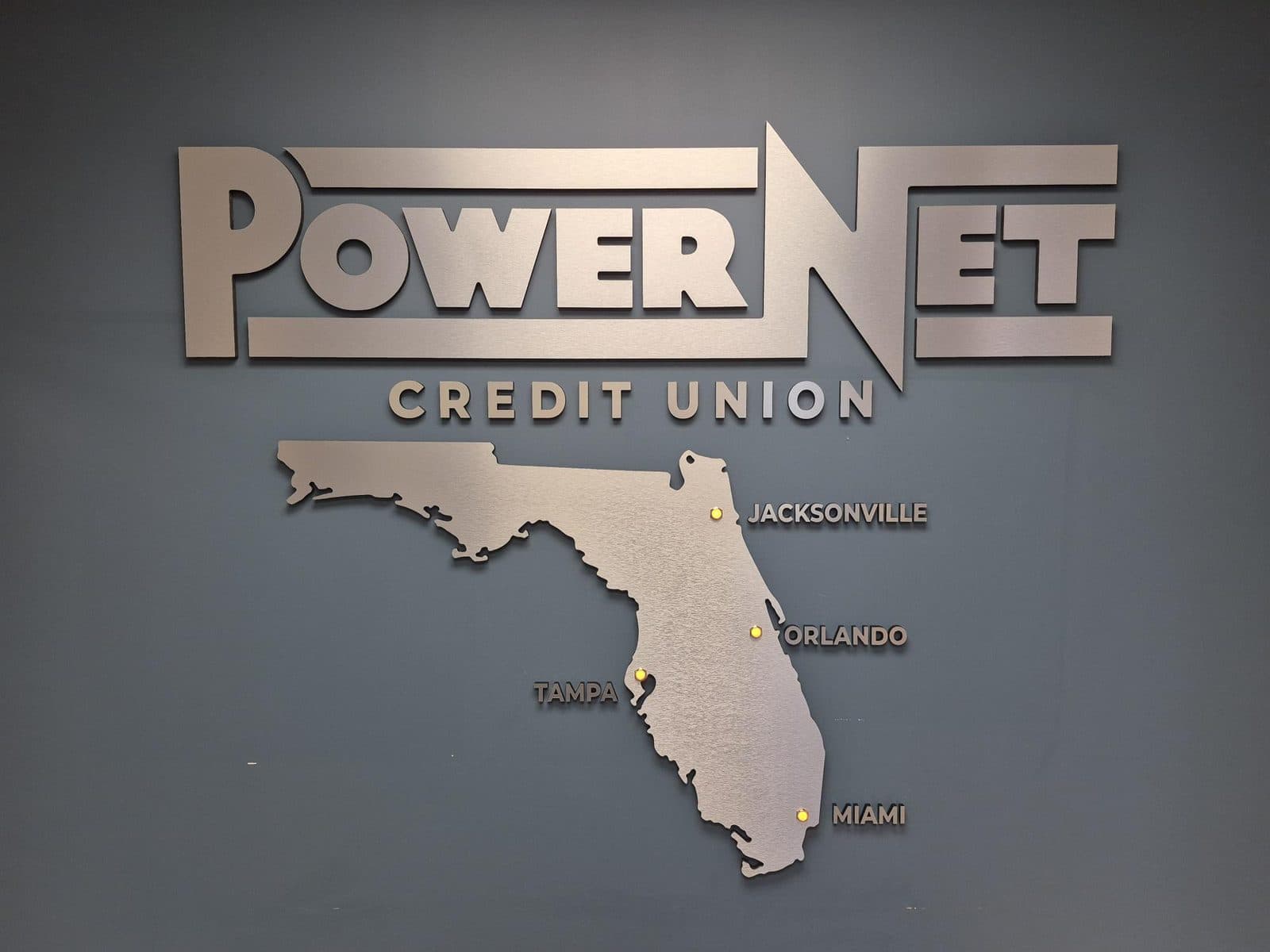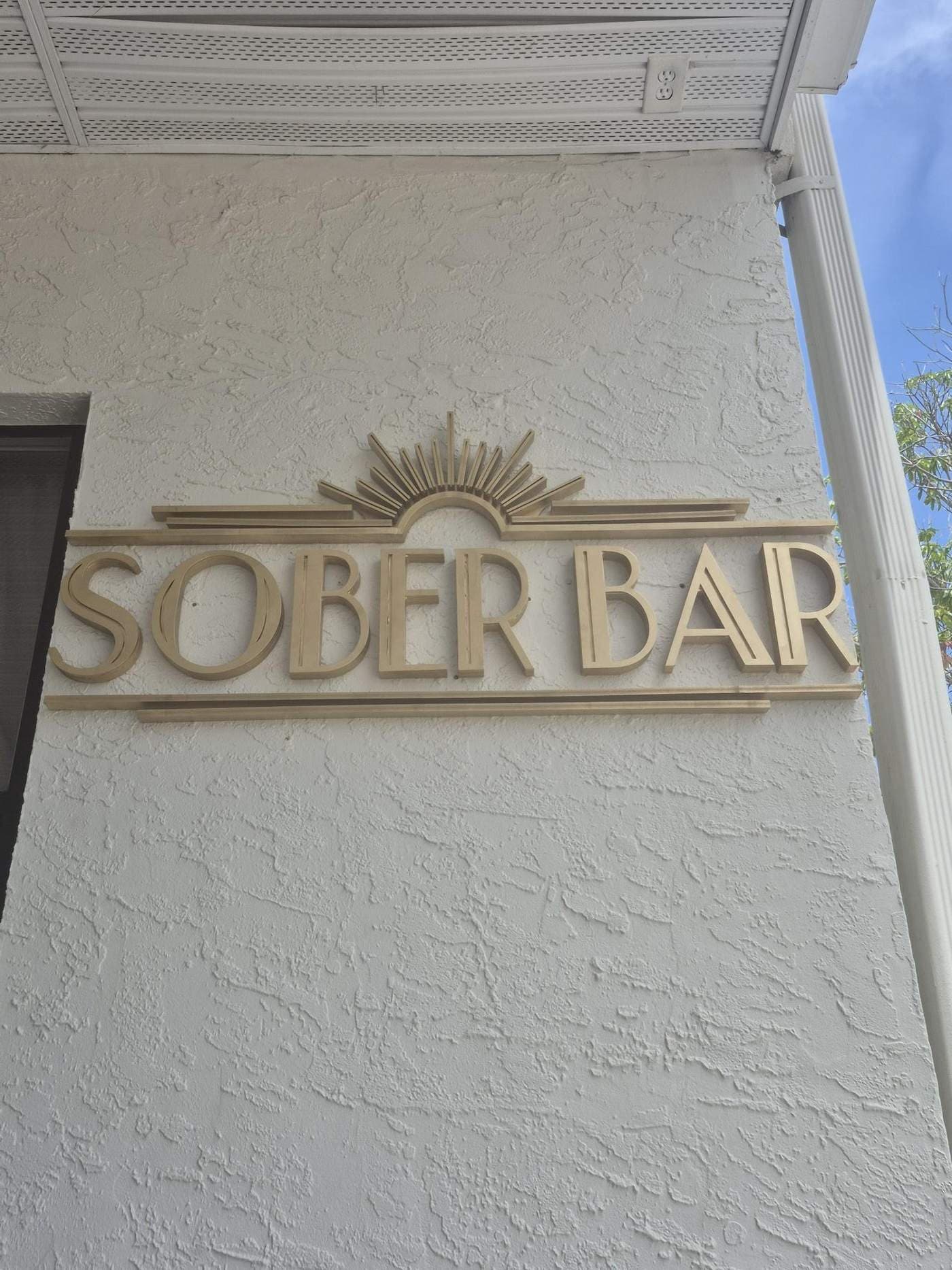
Halo-lit signs glow around the edges of a solid logo. Backlit signs glow through a printed face. Front-lit channel letters push light out of a translucent face on a storefront, and they are welded aluminum work. For a reception wall in Tampa, the first two are what we build: halo-lit and backlit LED signs cut, wired, and bench-tested in our shop.
This guide compares all three so you can tell which one your wall needs before you call anyone. We cover how each is built and which wall colors and finishes suit each style. We also cover what the U.S. Department of Energy says about LED life, and how Tampa treats interior lit signs on permits.
Key Takeaways
- Halo-lit suits an understated glow on a matte reception wall; backlit panels keep fine detail and full color.
- Face-lit channel letters are welded storefront work, a job for a metal sign fabricator.
- Good white LEDs last 30,000 to 50,000 hours of useful life (U.S. Department of Energy, LED Basics, retrieved 2026).
- Interior signs not visible from a public place appear exempt from Tampa sign permits; confirm at (813) 274-3100.
Which lighting style fits your wall?
Pick halo-lit for an understated glow on a reception wall, the most common request for our LED sign work. Pick a backlit panel when the logo has fine detail or full-color artwork. Edge-lit acrylic suits small accents, and face-lit channel letters belong on a storefront parapet. In 2026, Gemini describes halo-lit letters as having "depth and permanency" (Gemini Knowledge Hub, Comparing Lit Styles Between Halo Lit, Face Lit, Combo, and Two-Sided Lit Products, 2026).
The names describe where the light gets out. Halo-lit, also called reverse-lit, has an opaque face with LEDs inside facing the wall, so the glow appears around the shape (GRAPHICS PRO, A Deeper Look at Halo-Lit Channel Letters, 2019). Backlit means light passes through a translucent printed face. Face-lit letters push light through a diffused acrylic face set in a fabricated metal return.
| Style | How the light gets out | Reads best on | Best for | Watch out for |
|---|---|---|---|---|
| Halo-lit (reverse-lit) | Out the back, washing the wall around a solid shape | Matte, light-to-mid painted drywall | Reception walls, offices, studios | Glossy or dark walls dull or streak the halo |
| Backlit printed acrylic panel | Through a translucent printed face | Any wall color; the face carries the light | Detailed or full-color logos, counters | Needs vector or high-resolution art |
| Edge-lit acrylic | In at the polished edge, glowing across the panel | Desks, counters, small wall spots | Accents, room names, small logos | Small pieces only; light fades on big panels |
| Face-lit channel letters | Through a translucent face inside a metal can | Exterior parapets and fascias | Storefronts read from the street | Welded aluminum; a metal shop's job, not ours |
How is a halo-lit sign built?
A halo-lit sign is a solid logo or letter set with LEDs mounted behind it. Standoffs hold it off the wall so light washes the surface around each shape. In 2019, GRAPHICS PRO put the trade standard for standoff distance at "around 1.5 inches off the wall" (GRAPHICS PRO, A Deeper Look at Halo-Lit Channel Letters, 2019).
What we cut it from
We cut halo-lit pieces from acrylic, expanded PVC, or metal-finish aluminum composite, then fix LED modules to the back where the face hides them. Unlit, the sign still reads as a clean dimensional logo, which matters in a reception area that is busy all day. Unlit dimensional letters use the same cut files if you want the letterforms without the light.
Standoff distance and the shape of the halo
In our shop, 1 to 2 inches is the working range. A shorter standoff makes a tighter, brighter ring, and a longer one spreads a softer, wider wash. On reception walls we install, the mistake we see most often is a standoff picked before anyone looked at the wall.

Wall color, gloss, and LED color temperature
The wall does half the work. SloanLED's advice, quoted by GRAPHICS PRO in 2019, is to avoid glossy backgrounds "because you will see every module in the reflection" (GRAPHICS PRO, A Deeper Look at Halo-Lit Channel Letters, 2019). Matte stucco, brick, or rock work well, and flat-painted drywall behaves the same way in our experience. The same article pairs warmer 3000 to 5000 K LEDs with brown or stucco walls and cooler 6500 to 7100 K modules with darker facades.
Dark or heavily textured surfaces also swallow more of the light. We answer that with brighter modules and a shorter standoff rather than accept a dim ring, and we say so when a wall is going to fight the sign.
From the shop floor: We render every halo-lit logo against a photo of the customer's actual wall before anything is cut. A glow that looks right on flat white paint disappears on dark wood, and we would rather fix that on screen than on install day.
When does a backlit printed acrylic panel win?
A backlit panel wins when the logo has fine detail, gradients, or several colors that a solid silhouette would lose. Light passes through a translucent printed face, so the whole surface glows evenly. Gemini's 2026 guide credits face-lit letters to "high-quality diffused acrylic faces," and that same diffusion is what makes an interior backlit panel read cleanly (Gemini Knowledge Hub, Comparing Lit Styles Between Halo Lit, Face Lit, Combo, and Two-Sided Lit Products, 2026).
What the print needs
The panel is only as sharp as the file behind it. We build these as printed acrylic panels with a diffuser and LED modules spaced to the panel size. Send vector art or a high-resolution file, because a logo pulled off a website shows its pixels once light comes through it. Our guide on how to prepare a logo file covers formats.
Brightness under daytime store lighting
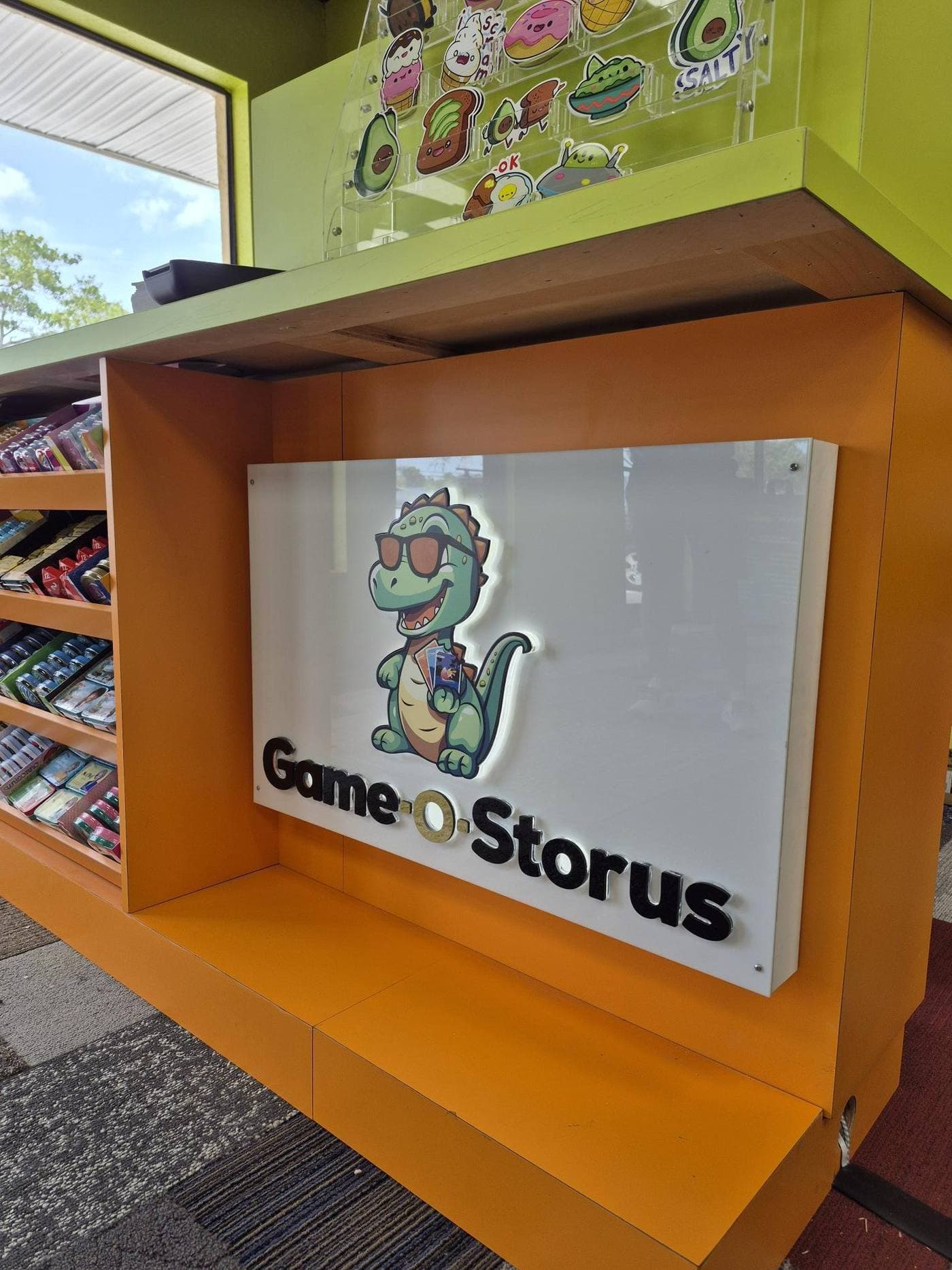
A backlit panel has to compete with the room. The Game-O-Storus counter sign in our gallery sits on an orange retail counter under bright store lighting, and it still reads because the face carries its own light. On the bench we power up every panel under our shop lights, which are brighter than most lobbies, and look for hot spots and dim edges.
Edge-lit acrylic, the small-piece cousin
Edge-lit panels put the LEDs in a groove along the panel edge, facing inward, so the acrylic "essentially glows from within" (GRAPHICS PRO, LED Edge Lighting Solutions, 2018). That 2018 article lists hospital lobbies, airport directional signs, and point-of-purchase displays as typical uses. We keep it for smaller accents, a desk piece or a room name, where a full backlit build would be more sign than the spot needs.
What are face-lit channel letters, and who builds them?
Face-lit channel letters are individual fabricated letters with metal sides, called returns, and a translucent acrylic face lit from inside. In 2026, Gemini describes them as using "expertly fabricated metal returns and high-quality diffused acrylic faces" (Gemini Knowledge Hub, Comparing Lit Styles Between Halo Lit, Face Lit, Combo, and Two-Sided Lit Products, 2026). They belong on exterior storefronts, and a metal sign fabricator builds them, not our shop.
Each letter is an aluminum can, bent and welded, then wired, sealed, and mounted to a raceway or straight to the parapet. We do not weld, so we do not build channel letters or lightbox cabinets. The interior equivalent we do build is a backlit printed acrylic panel: the light comes through the face the same way, without a welded can behind it.
Here is how to tell which one you need before calling anyone. If the sign has to read from across the parking lot at night, that is a channel-letter job for a metal sign fabricator. If it hangs on a wall inside, under a covered entry, or on a counter, that is our work. When a customer sends us a photo of a parapet, we say so in the first reply.
How long LED signs last, honestly
Good-quality white LEDs are expected to last 30,000 to 50,000 hours of useful life. That is measured to L70, the point where output has fallen to 70 percent of the original. As of 2026, the U.S. Department of Energy's LED Basics page gives both the range and the definition (U.S. Department of Energy, LED Basics, retrieved 2026).
Our math, by hours per day
Here is the arithmetic once. A sign lit 8 hours a day runs 8 × 365 = 2,920 hours a year, so 30,000 hours ÷ 2,920 = about 10.3 years. The table applies the same formula to the rest, and it is our math, not the DOE's.
| Hours lit per day | Hours per year | 30,000-hour L70 | 50,000-hour L70 |
|---|---|---|---|
| 8 (business hours) | 2,920 | about 10.3 years | about 17.1 years |
| 12 (open late) | 4,380 | about 6.8 years | about 11.4 years |
| 24 (never off) | 8,760 | about 3.4 years | about 5.7 years |
Those years cover the LED chips, not the whole sign. The DOE notes that color shift and failures in drivers and other electronics can come before the LEDs wear out (U.S. Department of Energy, LED Basics, retrieved 2026). That is why we size the low-voltage power supply with headroom, and why an interior sign that goes dark often needs a new supply rather than new modules.
Manufacturer ratings and the neon comparison
One manufacturer rates its channel-letter sign modules at more than 54,000 hours to L80 at an ambient temperature of 50 °C or lower (SloanLED, VL4 Channel Letter, retrieved 2026). L80 is a stricter mark than L70, and the temperature condition is the part to notice. Heat shortens LED life, which is one reason our covered-exterior halo letters get exterior-rated parts.
If you are replacing neon, a manufacturer representative told the trade press in 2018 that conversions "reduce their energy cost by 40 to 60 percent" (GRAPHICS PRO, Channel Letters: Non-Routine Retrofits, 2018). Neon transformers step line voltage up to 15,000 volts, while LED systems run on 12 to 24 volts DC. Treat that as a vendor's range, not a promise.
Power, safety listings, and permits in Tampa
An interior LED sign needs an outlet or a junction box behind it, plus a listed low-voltage power supply between the wall and the modules. As of 2026, the International Sign Association frames every electric sign as meeting two standards: UL 48 for safe design and fabrication, and the NEC for safe installation (International Sign Association, UL 48 Standard For Electric Signs, retrieved 2026).
UL 48 and NEC Article 600 in plain words
UL 48, Electric Signs, is in its 15th edition, revised May 14, 2025, and covers LED signs alongside neon and fluorescent (UL Standards & Engagement, UL 48 Electric Signs, 2025). NEC Article 600 adds the install rules. A 2013 EC&M explainer sums up the three that matter for a lobby sign (EC&M, NEC Rules for Electric Signs and Outline Lighting, 2013):
- 600.3: every electric sign must be listed and installed per its listing instructions.
- 600.6: each sign circuit needs a switch or breaker within sight of the sign, or one that locks in the open position.
- 600.24: Class 2 power supplies must be listed for electric signs or be a component in a listed sign.
Section numbers are stable, but that explainer predates the current code. Have your electrician verify against the edition adopted in Florida; the University of Florida's code list shows the 2020 NEC alongside the 2023 Florida Building Code (University of Florida EHS, Applicable Building Codes, retrieved 2026).
From the shop floor: The install-day delay we see most often is a wall with no power behind it. On new construction, ask your contractor to place an outlet or junction box where the sign will hang before the drywall closes.
Do you need a permit in Tampa?
As we read Tampa's sign code (Chapter 27, section 27-289.3), interior signs not visible from a public place are exempt from sign permits (Municode, Tampa Code of Ordinances §27-289.3 Allowable Signs, retrieved 2026). Confirm with Construction Services at (813) 274-3100 before you rely on it; the city's FAQ, updated in 2026, sends sign questions to that number (City of Tampa, Construction Services FAQ, 2026). The city's 2025 permit page defines a commercial sign as one "visible from a public place," so a lobby logo and a fascia sign differ (City of Tampa, Commercial Signs, 2025).
Any hard-wired connection goes through a licensed electrician, since the city's commercial electrical permit covers installing or extending wiring "inside or attached to any building" (City of Tampa, Commercial Electrical, 2025). A plug-in sign on an existing outlet is a different conversation, and the city pages do not answer it directly. In unincorporated Hillsborough County, electrical permits run through HillsGovHub, and the county's 2025 checklist lists low voltage among its plan elements (Hillsborough County, Commercial Electrical Permit Requirements, 2025). Our FAQ covers general installation questions and scheduling.
How to choose, and what to send us
Send us four things: a photo of the wall showing its color and finish, a rough size, your logo file, and whether there is an outlet behind the wall. Then tell us halo, backlit, or not sure. We render the logo both ways against your wall photo, so the choice gets made on screen. Our guide on what drives lobby sign cost covers the money side.
The decision rule is short. A solid logo or clean lettering on matte paint means halo-lit, and a logo with gradients, a photo, or fine linework means a backlit panel. A small desk or room-name piece means edge-lit. A sign on the outside of the building that has to read from the street means a metal sign fabricator.

Mixing styles is common. The Content Factory wall pairs a halo-lit cube logo with unlit gloss black letters below it, so the mark glows and the name stays crisp. Lit signs take longer than unlit ones because every module is wired and the finished sign is powered up on the bench, so we quote a timeline per project instead of promising a number of days. The quote form walks through the same four items.
Frequently Asked Questions
Is halo-lit the same as backlit?
No. Halo-lit light escapes behind an opaque shape and washes the wall, so you see a glowing outline. Backlit light passes through a translucent printed face, so the sign glows. In 2019, GRAPHICS PRO described halo-lit letters as having LEDs "mounted on a clear polycarbonate back facing into the letter" (GRAPHICS PRO, A Deeper Look at Halo-Lit Channel Letters, 2019). A backlit panel puts LEDs and a diffuser behind the printed face.
What is a reverse-lit letter?
Reverse-lit is another name for halo-lit. The face is opaque, the LEDs sit inside facing the wall, and the light leaves out the back. In 2019, GRAPHICS PRO noted most halo-lit channel letters are 3.5 inches deep (GRAPHICS PRO, A Deeper Look at Halo-Lit Channel Letters, 2019). Our interior versions are shallower, cut from acrylic, PVC, or metal-finish composite and set on standoffs instead of built as metal cans.
Which is brighter, front-lit or halo-lit?
Front-lit, or face-lit, is brighter to the eye because the light comes straight through the face toward you. Halo-lit is softer by design; you see light bounced off the wall, never the source. Of the interior styles we build, a backlit printed acrylic panel is the brightest, and it is what we suggest when a sign must compete with bright store lighting.
Do backlit signs work on dark walls?
Yes. A backlit panel carries its own light through its face, so wall color barely matters. Halo-lit is the style that depends on the wall; SloanLED's advice via GRAPHICS PRO in 2019 is to avoid glossy backgrounds because every module shows in the reflection (GRAPHICS PRO, A Deeper Look at Halo-Lit Channel Letters, 2019). On a dark wall we render halo and backlit side by side before recommending either.
How long do LED signs last?
The U.S. Department of Energy puts good-quality white LED useful life at 30,000 to 50,000 hours, measured to L70 (U.S. Department of Energy, LED Basics, retrieved 2026). By our math, that is roughly 10 to 17 years at 8 hours a day, or 7 to 11 years at 12. The DOE also notes drivers and electronics can fail first, so a dark sign often needs a new power supply, not new LEDs.
Do I need a permit for an interior lighted sign in Tampa?
As we read Tampa's Chapter 27, section 27-289.3, interior signs not visible from a public place are exempt from sign permits (Municode, Tampa Code of Ordinances §27-289.3 Allowable Signs, retrieved 2026). Confirm with Construction Services at (813) 274-3100. A hard-wired power connection is a separate question: have a licensed electrician run it and confirm whether an electrical permit applies. A plug-in sign on an existing outlet is usually simpler, but ask.
The short version
Halo-lit when you want the wall to glow around a solid logo. Backlit when the logo needs its detail and color to survive being lit. Edge-lit for small accents, and face-lit channel letters for a storefront parapet, from a metal shop rather than us. Pick the wall first, then the style, then the size.
Send a wall photo, a rough size, your logo file, and a note about power through our request a quote form. We will show you the logo rendered halo-lit and backlit before anything is cut. Lit signs take more bench time than unlit ones, and we will give you a straight answer on what is realistic.
Sources
- Gemini Knowledge Hub, Your Expert Guide: Comparing Lit Styles Between Halo Lit, Face Lit, Combo, and Two-Sided Lit Products, retrieved 2026-09-30, https://hub.geminimade.com/knowledge/your-expert-guide-comparing-illuminated-styles-between-halo-lit-face-lit-combo-and-two-sided-lit-products
- GRAPHICS PRO (Tony Kindelspire), A Deeper Look at Halo-Lit Channel Letters, retrieved 2026-09-30, https://graphics-pro.com/feature/hello-halo-a-deeper-look-at-halo-lit-channel-letters/
- GRAPHICS PRO (Matt Dixon), LED Edge Lighting Solutions, retrieved 2026-09-30, https://graphics-pro.com/feature/led-edge-lighting/
- GRAPHICS PRO (Ryan Fugler), Channel Letters: Non-Routine Retrofits, retrieved 2026-09-30, https://graphics-pro.com/feature/channel-letters-non-routine-retrofits/
- U.S. Department of Energy, LED Basics, retrieved 2026-09-30, https://www.energy.gov/eere/ssl/led-basics
- SloanLED, VL4 Channel Letter, retrieved 2026-09-30, https://sloanled.com/collection/signage/channel-letter-signage/vl4/
- UL Standards & Engagement, UL 48 Electric Signs (Ed. 15, rev. May 14, 2025), retrieved 2026-09-30, https://www.shopulstandards.com/ProductDetail.aspx?UniqueKey=23299
- International Sign Association, UL 48 Standard For Electric Signs, retrieved 2026-09-30, https://signs.org/codes-regulations/technical-codes-and-standards/ul-48-standard-for-electric-signs/
- EC&M (Mike Holt), NEC Rules for Electric Signs and Outline Lighting, retrieved 2026-09-30, https://www.ecmweb.com/national-electrical-code/code-basics/article/20897382/nec-rules-for-electric-signs-and-outline-lighting
- University of Florida EHS, Applicable Building Codes, retrieved 2026-09-30, https://www.ehs.ufl.edu/?p=2001
- Municode, Tampa Code of Ordinances Ch. 27 Art. VI Div. 6 §27-289.3 Allowable Signs, retrieved 2026-09-30, https://library.municode.com/fl/tampa/codes/code_of_ordinances?nodeId=COOR_CH27ZOLADE_ARTVISURE_DIV6SI_S27-289.3ALSI
- City of Tampa, Construction Services FAQ, retrieved 2026-09-30, https://www.tampa.gov/construction-services/how-do-i
- City of Tampa, Commercial Signs, retrieved 2026-09-30, https://www.tampa.gov/construction-services/commercial-permits/signs
- City of Tampa, Commercial Electrical, retrieved 2026-09-30, https://www.tampa.gov/construction-services/commercial-permits/electrical
- Hillsborough County, Commercial Electrical Permit Requirements, retrieved 2026-09-30, https://hcfl.gov/businesses/hillsgovhub/commercial-construction-checklists-and-requirements/commercial-electrical-permit-requirements
About the author
Bryan · Owner, Bryan Fabrication Works
Bryan owns and runs Bryan Fabrication Works, a Tampa sign shop that designs, cuts, finishes, and installs lobby signs, halo-lit LED signs, dimensional letters, ADA signage, and memorial boards under one roof. The guides here come from the questions customers ask him during quotes, and from the jobs in the portfolio.
More about the shop