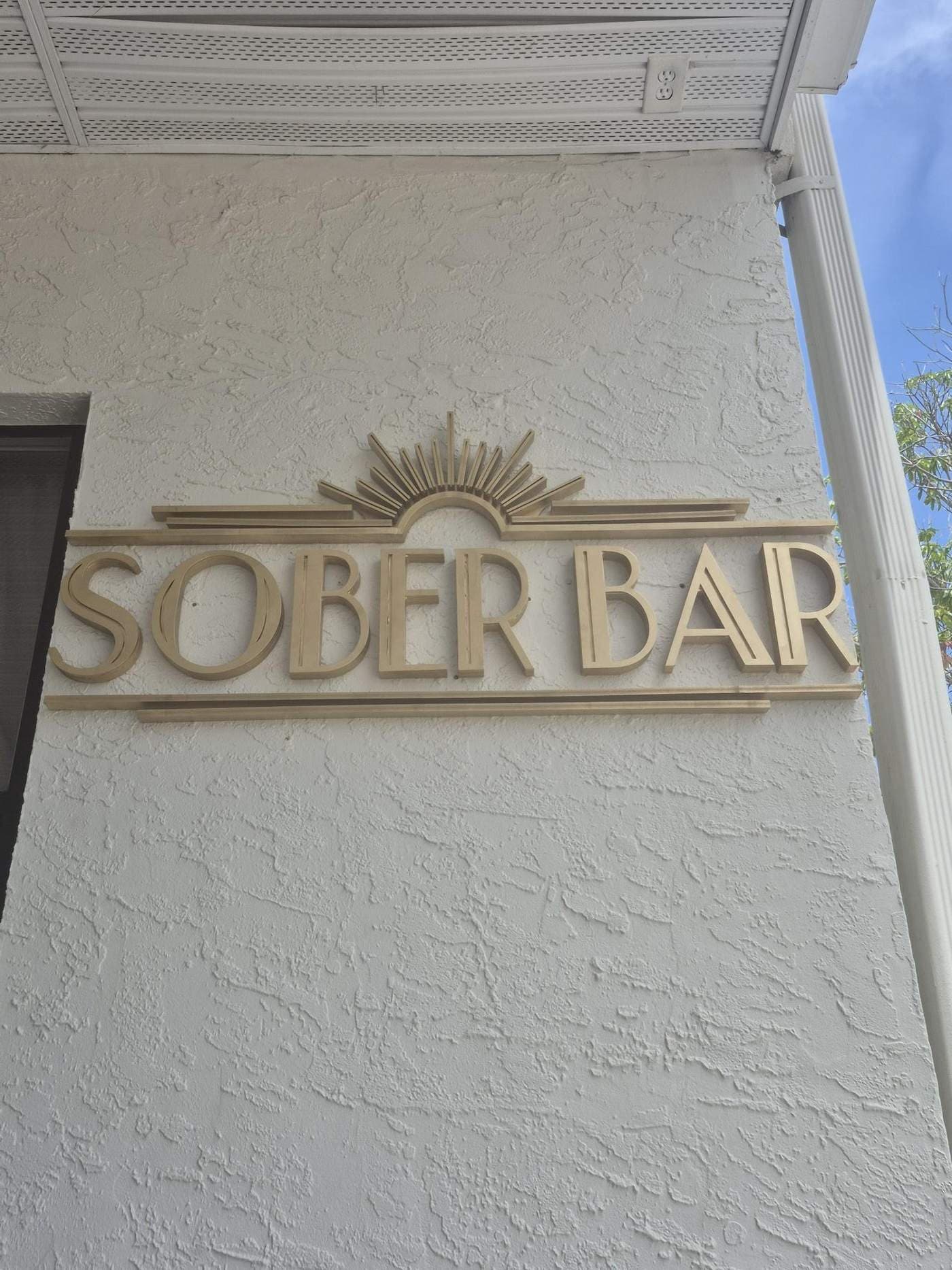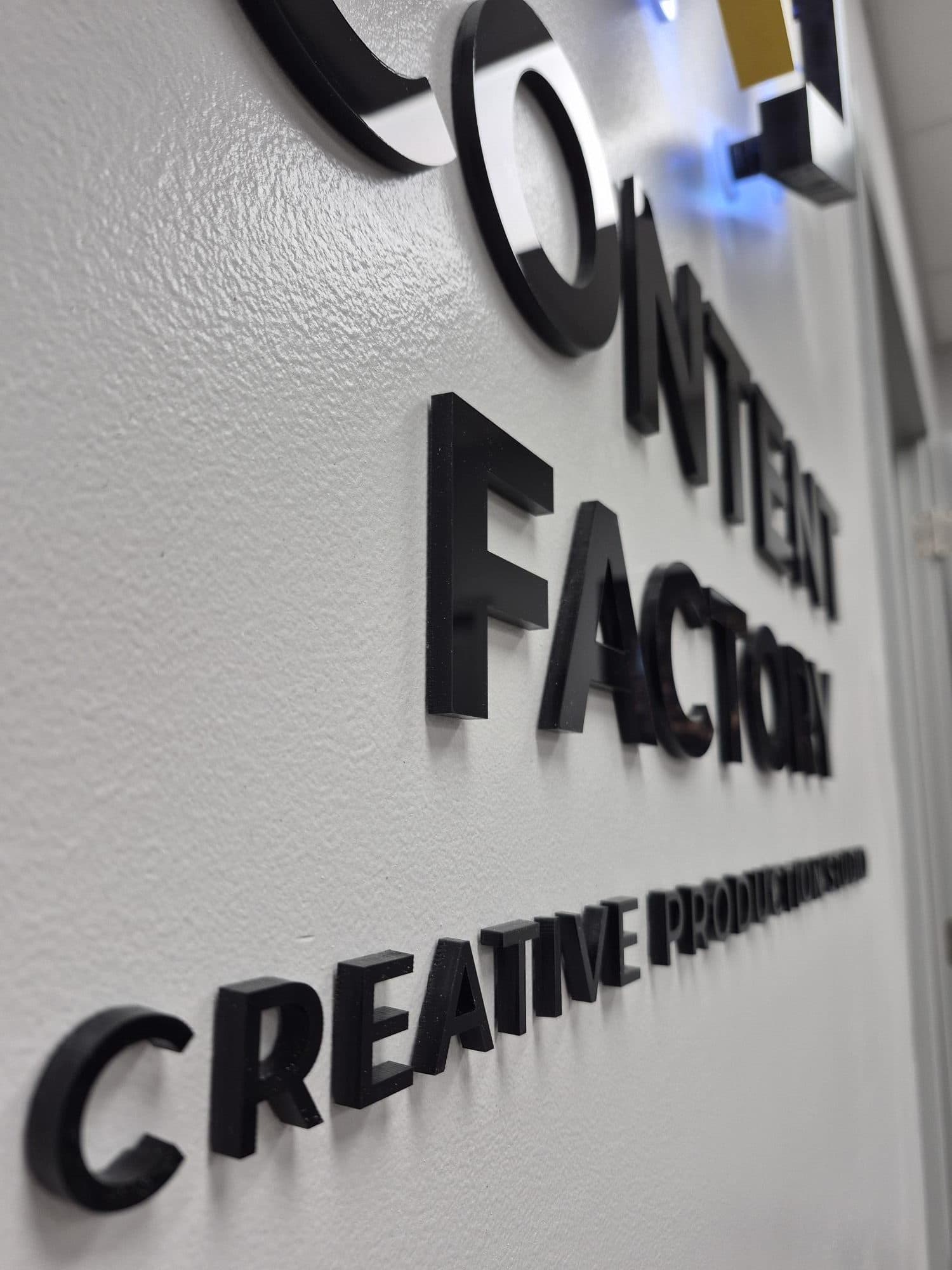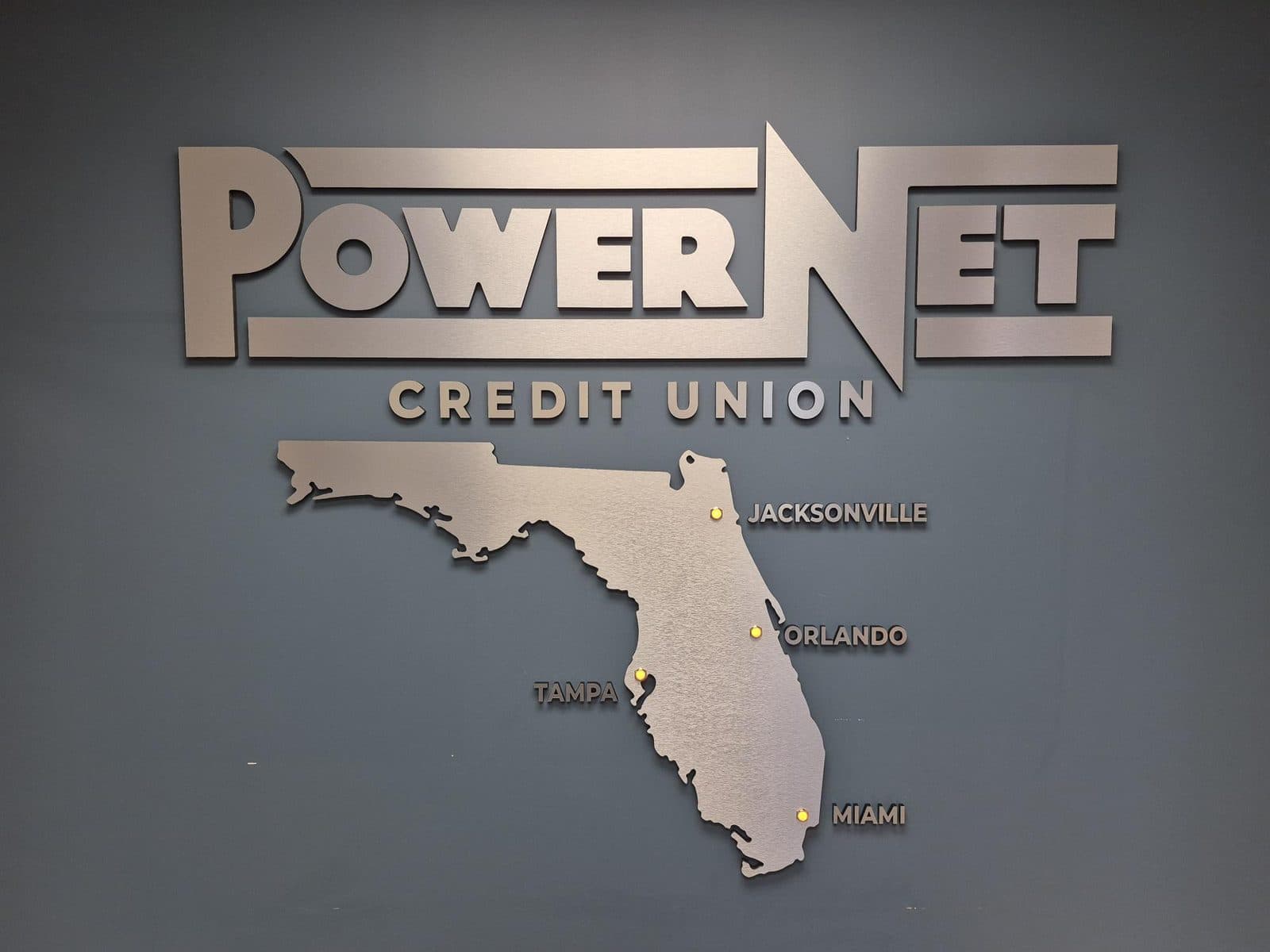
There is no single lobby sign price, and any page that hands you one without showing its work is guessing. Every job we build is quoted on its own. A set of painted letters and a halo-lit brushed metal-finish logo wall are not the same job. Our lobby signs in Tampa page covers what we build; this guide covers what moves the number.
Four things do most of the work: size and piece count, material and finish, mounting and the wall, and whether the sign is lit. Below we walk through each one with the figures that exist and the shop practice that fills the gaps. By the end you should know whether your sign sits on the low end or the high end.
Key Takeaways
- HomeAdvisor's 2026 commercial sign guide reports a $464 average and a $181 to $804 range, but it lumps every sign type together.
- Shops price by pieces and machine time, so ten small letters usually cost more than one large logo shape.
- Raw sheet material is a small share; finishing, hardware, lighting, and install are the rest.
- Send a logo, a wall photo, and wall dimensions for a real number.
Why isn't there one lobby sign price?
Because a lobby sign is a custom build, not a catalog item. The closest national reference is HomeAdvisor's commercial sign guide, updated in June 2026. It reports an average of $464 and a normal range of $181 to $804 (HomeAdvisor, What Does Commercial Sign Installation Cost in 2025?, 2026). That guide covers every commercial sign type, so it is a rough marker only.
HomeAdvisor says it surveys real customers after a project is complete. It does not disclose the sample size, and there is no lobby sign line item. The same guide lists $10 to $300 per square foot, so a small printed panel and a large electrical storefront sign share one average.
As of September 2026, FASTSIGNS' own cost page publishes no dollar figures at all. It lists size, design complexity, lighting, materials, and installation as the drivers and tells you to talk to a center (FASTSIGNS, Sign Costs & Completion Time, 2026). Other shops publish unsourced ranges, from a few hundred dollars for a small printed panel to five figures for a lit brushed-metal wall. None show where the numbers came from.
Three things move the price most, in this order: size and piece count, material and finish, and whether it is lit. Mounting method and wall type modify the install line on top of that. The sections below help you place your own sign before you ask for a number.
From the shop floor: The same 36-inch logo can be quoted three ways on one proof: painted PVC, brushed metal-finish composite, and halo-lit acrylic. Wall, artwork, and size stay identical, and the low and high versions are still far apart. That spread is why we don't publish a menu.
How do size and letter count change the price?
Shops price by pieces and machine time, not by square feet alone. A ten-letter company name in 8-inch letters usually costs more than a single 30-inch logo shape of similar total area. Every letter is its own cut path, its own edges to sand and paint, and its own set of studs to bond, drill for, and set.
Small letters are also fussier than big ones. Counters, the holes inside an O or a B, need their own routing pass. Thin strokes on a script font force slower feeds or thicker stock so the letter survives handling. Ten letters means ten of everything, including ten template holes and ten chances to be off level.
Size pushes cost through thickness. A 30-inch letter cut from 1/8-inch sheet reads like a decal from the door. Bigger letters move to 1/4-inch, 1/2-inch, or thicker stock, which costs more and cuts slower. That is why we size dimensional letters to the sightline from your entrance first, then pick the thickness that makes that size look solid.
On reception walls we lay out, the request that raises the price most quietly is the tagline. Three words under a logo can add more pieces than the logo itself, each one small and slow to cut, mask, and paint. If the budget is tight, that tagline is the first thing we suggest moving to cut vinyl or leaving off.
Which lobby sign material costs the least?
Painted expanded PVC or high-density foam usually makes the least expensive finished letter, and the reason is not the sheet price. As of September 2026, a 1/4-inch cast acrylic 4x8 sheet lists at $163.20 (Estreet Plastics, 1/4" x 48" x 96" Clear Acrylic Plexiglass Cast Sheets, 2026). A 3mm Dibond sheet runs $160 to $295 depending on finish (Set Shop NYC, Aluminum Panel / Dibond, 2026).
A 1/2-inch white expanded PVC sheet lists higher, at $301.56 (ePlastics, 1/2" X 48" X 96" White Sintra Celtec PVC Foam Sheet, 2026). That sheet is twice the thickness of the acrylic, though, so the comparison is loose. The point is that acrylic and aluminum composite sit in the same band per sheet, and none of these sheets is the expensive part.
One 4x8 sheet yields a lot of letters, so what you are mostly paying for is CNC time, edge cleanup, paint coats, and masking for multi-color logos. Then come studs and standoffs, LED parts if lit, and the hours on a ladder at your wall. Brushed metal-finish costs more than painted PVC for two reasons. In our experience brushed stock costs more than plain white panel, and its cut edges take more finishing to look clean.
| Material | Relative cost (finished) | Weight | Where it fits |
|---|---|---|---|
| Brushed aluminum composite (3mm ACM) | Mid to high; brushed stock and edge finishing add to it | Two .012" aluminum skins on a polyethylene core, about half the weight of solid aluminum (3A Composites USA, Dibond, 2026) | The metal look on a reception wall: logos, plaques, cut maps |
| Painted acrylic (1/4" to 1/2") | Mid to high; several paint coats and masking add labor | Specific gravity 1.19, the heaviest of these four (Plaskolite, OPTIX Acrylic, 2026) | Exact brand colors, gloss finish, halo-lit faces |
| Printed acrylic | Mid; one print pass replaces color-by-color painting | Same as painted acrylic | Gradients, photos, and multi-color logos on one panel |
| Expanded PVC (1/2") | Low to mid; cuts fast, takes paint well | About 0.55 g/cm³, roughly half the density of acrylic by our math (Emco Plastics, Komatex PVC Sheet, 2026) | Large painted letters, budget statement walls |
| High-density urethane foam (15 lb) | Low to mid for thick letters; always primed and painted | 15 lb/ft³, roughly one-fifth of acrylic by our math (Laird Plastics, High Density Foam Board, 2026) | Very thick, very large letters that must stay light |
Weight is a cost item, not just a spec. Heavier letters need more studs, and big acrylic letters on hollow drywall sometimes need blocking before we can hang them. Our guide to letter materials compared goes deeper, including how each one handles Tampa heat. Frosted, clear, and printed panels are covered on the acrylic signs page.
Mounting hardware and the wall you're hanging on
The mount is its own cost line, and the wall behind it sets the install time. Gemini's September 2026 product guide defines stud mounting as "threaded rods installed into the back of the sign and mounted into pre-drilled holes" (Gemini Product Guide, Mounting Hardware: The Foundation Behind Every Sign, 2026). That is our default for letters and logos, and it is the cheapest.
That same guide describes pad mounts as plastic pads with threaded thru holes that spread pressure on corrugated or irregular surfaces. It defines standoffs as hardware that "create separation between a sign and the mounting surface" for a floating look. Standoffs cost more than studs. You are buying decorative barrels, offered in 1/2-inch and 1-inch diameters with 3/4-inch or 1 1/2-inch projections (Gemini Product Guide, Mounting Hardware Options, 2026), plus a panel to carry them.
Drywall is the fast case: level the paper template, drill, set studs, done. Concrete block is the slow one, with masonry bits, anchors, and dust. Wood slat walls need the pattern set to the slats, and tile needs special bits plus a layout that respects grout lines.
In Tampa we hit concrete block behind the finish wall often enough that we ask about it before quoting. A wall photo tells us a lot, but if you know the building is block, say so. It changes the drill bits, the anchors, and the hours.
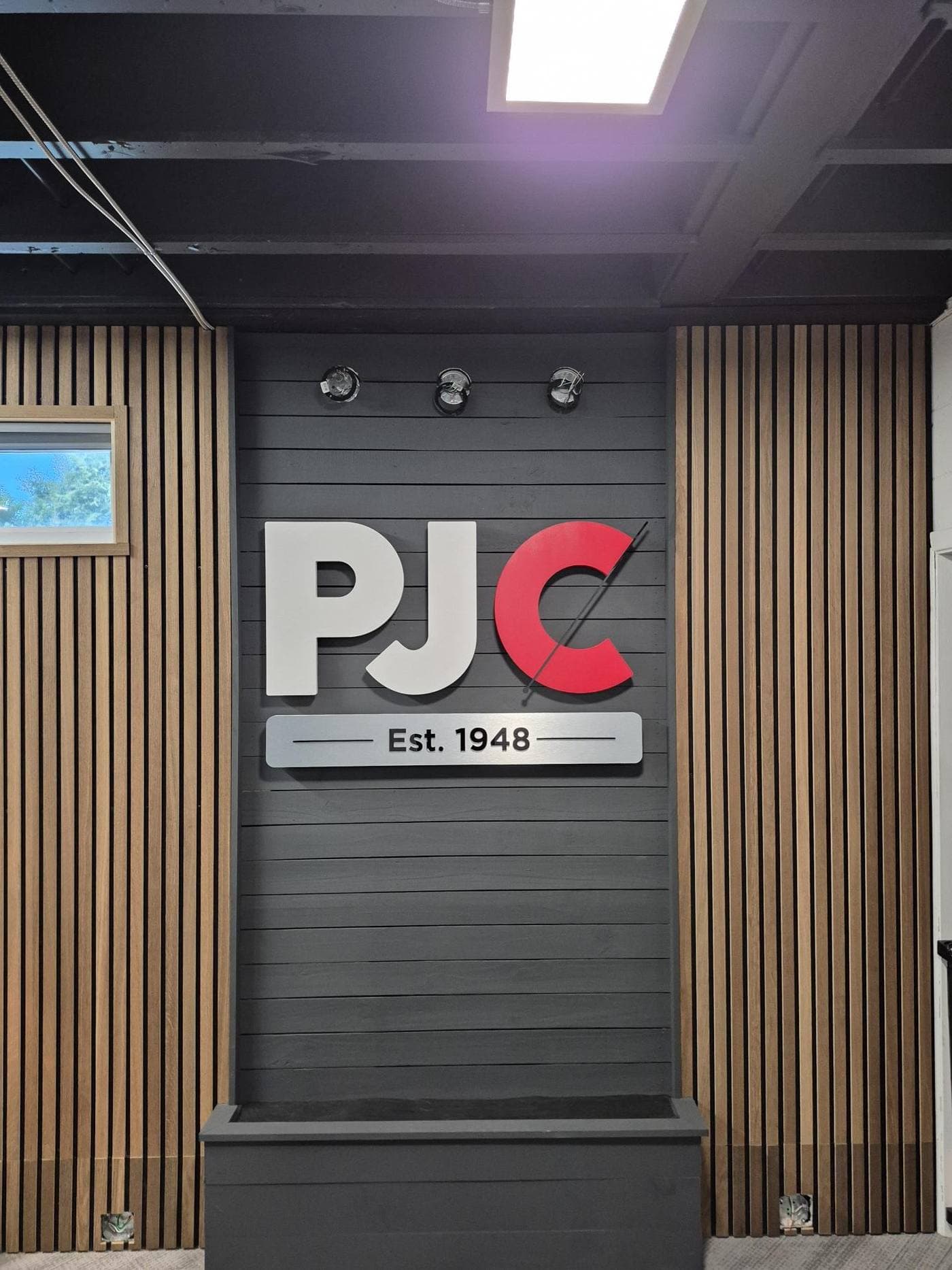
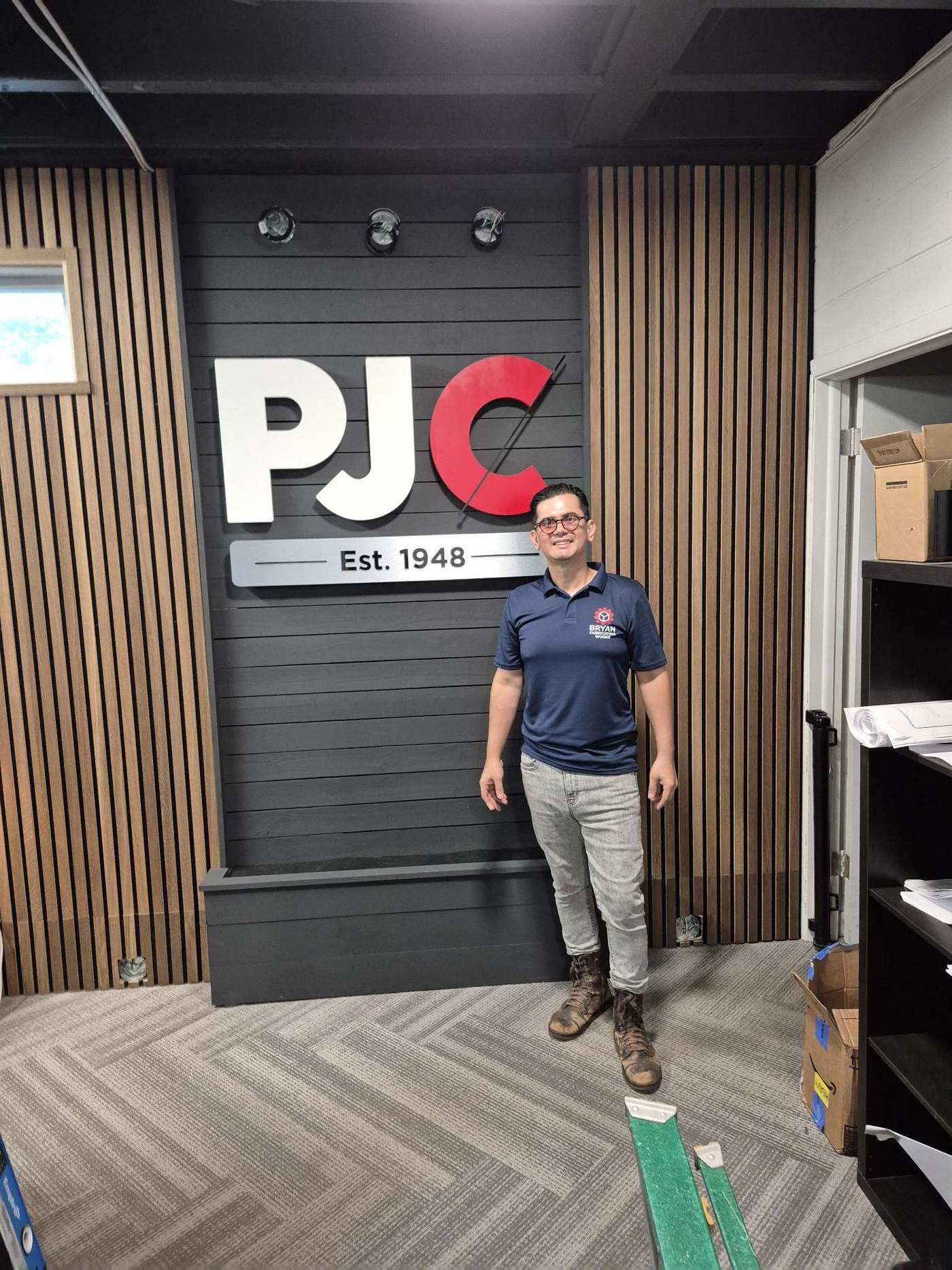
From the shop floor: The PJC letters shown earlier went onto a wood-slat wall with open gaps between the boards. We set the template to the slats rather than to the wall, so every stud landed in wood and none in a gap. Lining up that pattern took longer than the drilling, which is the kind of hour a straight-on wall photo lets us see coming.
What does a halo-lit lobby sign add to the cost?
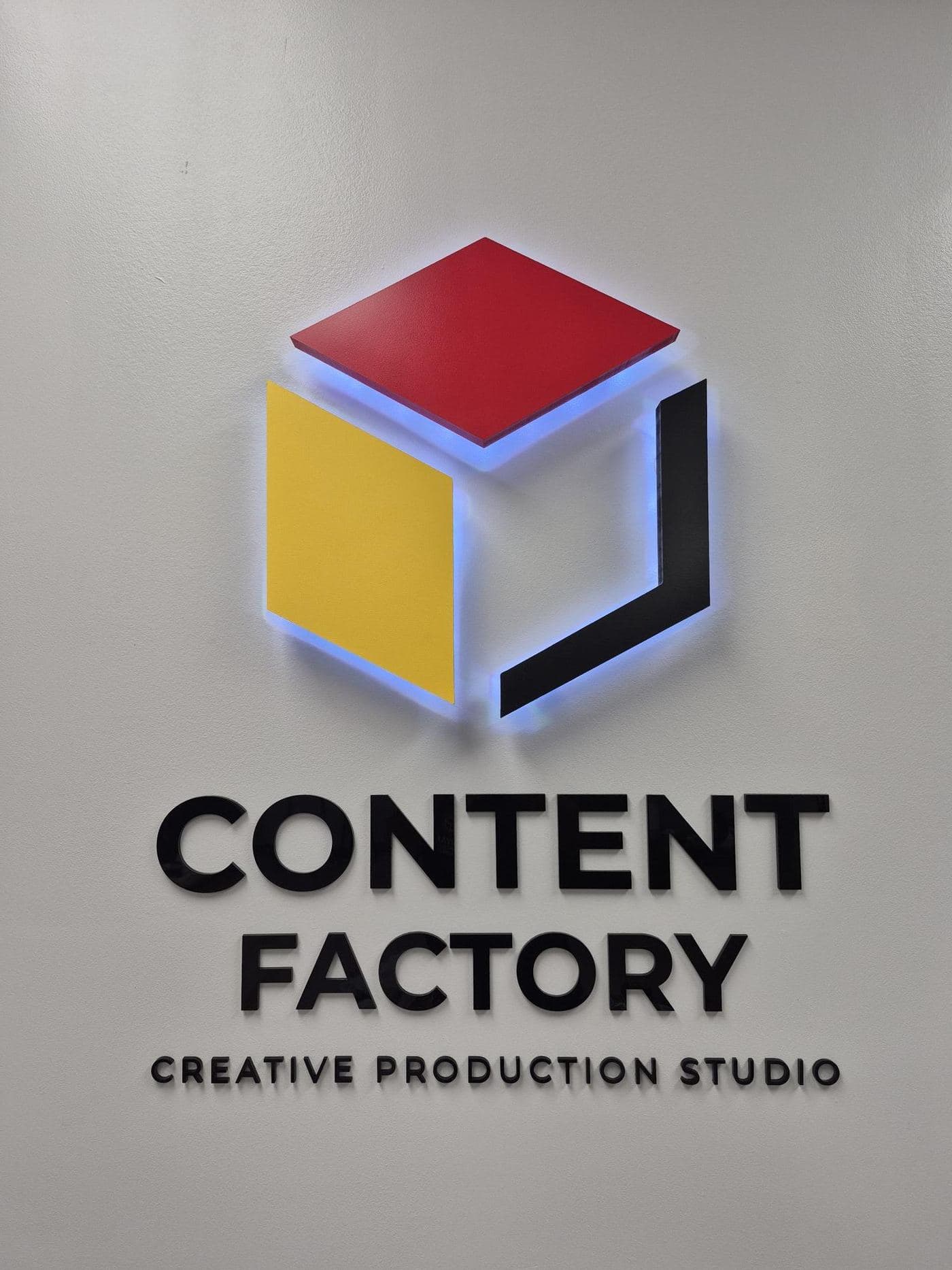
Parts, labor, and a power source. A halo-lit build needs LED modules behind each piece, a low-voltage power supply to run them, and an outlet or junction box behind the wall to feed that supply. We bench-test the whole assembly before it leaves the shop. Every one of those is a line an unlit sign never has.
Customers forget the electrical side, which HomeAdvisor's guide lists as a separate item at $560 to $2,300 for commercial signs (HomeAdvisor, What Does Commercial Sign Installation Cost in 2025?, 2026). That range covers every sign type. An interior lobby sign usually just needs its power supply plugged into an outlet or hardwired to a box behind the wall. If there is no power where the sign goes, adding it is an electrician's job, and it has to happen before install day.
Why do lit pieces take longer to build? A halo-lit letter needs a backer and a return deep enough to house the modules and throw light evenly. It mounts on standoffs so the glow has somewhere to go. A backlit face needs white or clear acrylic that diffuses light instead of blocking it.
Both add cut time, assembly time, and wiring time. Our LED signs page covers what we build, and we compare the styles in halo-lit vs backlit vs front-lit. One limit worth stating: we build illuminated signs for interior and covered-exterior locations only, and a lit reception wall is squarely in that lane.
What the research says about signage and sales
The research says signs influence buying, but it studies signage broadly, not lobby signs in particular. In a 2012 survey commissioned by FedEx Office, 68 percent of 1,000 US adults said a store's signage reflects the quality of its products or services (FedEx Newsroom, FedEx Office Survey: Standout Signs Contribute to Sales, 2012). The same survey found 52 percent were less willing to enter a store with misspelled or poorly made signs.
A 2011 University of Cincinnati release described a study, sponsored by the Signage Foundation, that surveyed more than 160 large and small businesses (phys.org, Research examines the economic value of on-premise signs, 2011). Of those, 75 percent had changed their sign design in the previous five years. Businesses that updated reported increases of about 10 percent in sales, profits, and transactions (Printing News, Industry Insights: The Economic Value of Signs, 2012). The Sign Research Foundation's summary of that 2012 report calls signs "silent salespersons" (Sign Research Foundation, Economic Value of On-Premise Signage, 2012).
Two honest caveats: those gains were self-reported, and both studies were commissioned by organizations with a stake in selling signs. Nobody walks into an accounting office because of the logo behind the desk. Where the research does apply is the perception finding. The sign is in the background of every first meeting, every waiting-room minute, and every photo taken in your space.
How to get a real number fast
Send five things and you'll get a specific price instead of a range. We need your logo file, a straight-on wall photo, and rough wall width and height. Add your brand colors, whether you want it lit, and where the nearest outlet is. With those we lay the sign out at true scale and price the build that fits your wall.
The proof you get back shows size, material, finish, and mounting method. It is usually composited onto your own wall photo so you can judge scale with your eyes. Vector artwork makes that faster, but we rebuild logos from website images and business cards regularly. Our guide on preparing a logo file explains what to send, and the quote form walks through the same list.
If the first number is higher than you hoped, there are ways to bring it down that don't look like cutting corners. These are the moves we suggest most often. Each one keeps the sign the right size, which is the thing visitors actually notice.
| Move | Why it saves | What you give up |
|---|---|---|
| Right size in a cheaper material | Piece count and size drive labor; a correctly sized painted PVC logo beats a too-small brushed one | The metal look, for now |
| Unlit now, lit later | Skips LED modules, power supply, and wiring today; we build in the standoff depth and pass-through an LED version needs | The glow, until you add it |
| Painted PVC for very large letters | Half the density of acrylic and quick to cut, so big letters stay light and affordable | The gloss depth of painted acrylic |
| Tagline in cut vinyl, logo dimensional | Removes the smallest, slowest pieces from the CNC and paint queue | Depth on the tagline only |
Our service page says it and it bears repeating here. The cheaper build in the right size beats the more expensive build in the wrong one, and we will tell you when that's the case. We lay out every proof that way before we talk about budget.
Frequently Asked Questions
Does the lobby sign price include installation?
Only if the quote says so; ours lists installation as its own line. We recommend our install, because a lobby sign is viewed straight-on from a few feet away and any error in level shows. If your facilities team prefers to hang it, we ship the sign with a full-size paper template and the right hardware for your wall type. Like most custom work, the job starts with a deposit.
What is the cheapest material for a lobby sign?
For large letters, painted expanded PVC or high-density foam. Expanded PVC is about 0.55 g/cm³, roughly half the density of acrylic by our math. It cuts fast and takes paint well, so a big letter costs less to make and less to hang. For a small logo, one printed acrylic panel on four standoffs is often cheapest. The sheet price is not the reason; labor per piece is.
Are backlit lobby signs worth the extra cost?
If your lobby is used after dark, or visitors wait in it, usually yes. Lighting is the one upgrade that changes how the room feels after hours. In the 2012 FedEx Office survey, 68 percent of consumers said signage reflects a business's quality. If the budget is tight, build it unlit now with the standoff depth and pass-through an LED version needs, and add the lighting later.
How long does a lobby sign take to make?
It's quoted per project, so we won't promise a blanket number of days. Design and proofing move quickly once we have your logo and wall photo; fabrication starts after you approve the proof. Lit signs take longer than unlit ones because of wiring and bench testing, and painted finishes need cure time. Tell us a hard deadline at the start and we'll say plainly whether it's realistic.
What size should a reception sign be?
Larger than most people first ask for. A reception logo often reads best at roughly half to two-thirds of the usable wall width behind the desk. The distance from the front door to the wall decides it. Measure that distance and the wall width and send both with your photo. We lay the sign out at true scale on the photo so you judge size before cutting.
The short version
Lobby sign cost comes down to pieces, material, mounting, and light. Many small letters cost more than one big shape. Brushed composite and painted acrylic cost more per finished piece than painted PVC, but the sheet is never the expensive part. Studs are cheaper than standoffs, drywall is faster than block, and lit adds parts and hours.
The national figures you'll find online, including HomeAdvisor's $464 average, lump every commercial sign together and don't describe your wall. Send us a logo, a straight-on photo, and rough dimensions, and we'll send back a proof and a price for the sign you actually want. Details on what we build are on the lobby and reception sign page.
Sources
- HomeAdvisor, What Does Commercial Sign Installation Cost in 2025?, retrieved 2026-09-30, https://www.homeadvisor.com/cost/safety-and-security/make-and-install-signs
- FASTSIGNS, Sign Costs & Completion Time, retrieved 2026-09-30, https://www.fastsigns.com/help-support/sign-costs-completion-time/
- Estreet Plastics, 1/4" x 48" x 96" Clear Acrylic Plexiglass Cast Sheets, retrieved 2026-09-30, https://estreetplastics.com/product/1-4-x-48-x-96-clear-acrylic-plexiglass-cast-paper-mask/
- Set Shop NYC, Aluminum Panel / Dibond, retrieved 2026-09-30, https://setshop.com/aluminum-panel-dibond/
- ePlastics, 1/2" X 48" X 96" White Sintra Celtec PVC Foam Sheet, retrieved 2026-09-30, https://www.eplastics.com/PVCWHT0-500FOAM48X96
- 3A Composites USA, Dibond, retrieved 2026-09-30, https://3acompositesusa.com/products/dibond/
- Plaskolite, OPTIX Acrylic, retrieved 2026-09-30, https://plaskolite.com/catalog/optix-acrylic
- Emco Plastics, Komatex PVC Sheet, retrieved 2026-09-30, https://www.emcoplastics.com/komatex/
- Laird Plastics, High Density Foam Board | HDU Sheets, retrieved 2026-09-30, https://lairdplastics.com/all-products/high-density-foam-board-hdu/
- Gemini Product Guide, Mounting Hardware: The Foundation Behind Every Sign, retrieved 2026-09-30, https://hub.geminimade.com/knowledge/mounting-hardware-the-foundation-behind-every-sign
- Gemini Product Guide, Mounting Hardware Options, retrieved 2026-09-30, https://hub.geminimade.com/knowledge/sign-hardware-us
- FedEx Newsroom, FedEx Office Survey: Standout Signs Contribute to Sales, retrieved 2026-09-30, https://newsroom.fedex.com/newsroom/global-english/fedex-office-survey-standout-signs-contribute-to-sales
- phys.org (University of Cincinnati release), Research examines the economic value of on-premise signs, retrieved 2026-09-30, https://phys.org/news/2011-10-economic-on-premise.html
- Printing News, Industry Insights: The Economic Value of Signs, retrieved 2026-09-30, https://www.printingnews.com/wide-format-signage/article/10824541/industry-insights-the-economic-value-of-signs
- Sign Research Foundation, Economic Value of On-Premise Signage, retrieved 2026-09-30, https://signresearch.org/economic-value-on-premise-signage/
About the author
Bryan · Owner, Bryan Fabrication Works
Bryan owns and runs Bryan Fabrication Works, a Tampa sign shop that designs, cuts, finishes, and installs lobby signs, halo-lit LED signs, dimensional letters, ADA signage, and memorial boards under one roof. The guides here come from the questions customers ask him during quotes, and from the jobs in the portfolio.
More about the shop